Speaker polarity test: check for out-of-phase wiring
Check if a speaker is wired out of phase with a low sine and a phase-invert switch: thin or full bass tells you if the pair is right, and how to fix it.
What does out-of-phase speaker wiring mean?
A speaker is wired out of phase (reversed polarity) when the positive (+) and negative (−) leads of one speaker in a pair are swapped. One cone then pushes out while the other pulls in, so at the listening seat between them the two sound waves partly cancel.
The bass cancels most, because the two channels are almost identical there. The result: thin bass, a vocal that will not sit in the centre, and a blurred stereo image. Each speaker sounds fine on its own, which is why this fault is so easy to miss.
How to check polarity with a phase-invert switch
- Sit in your listening position, centred and equally distant from both speakers.
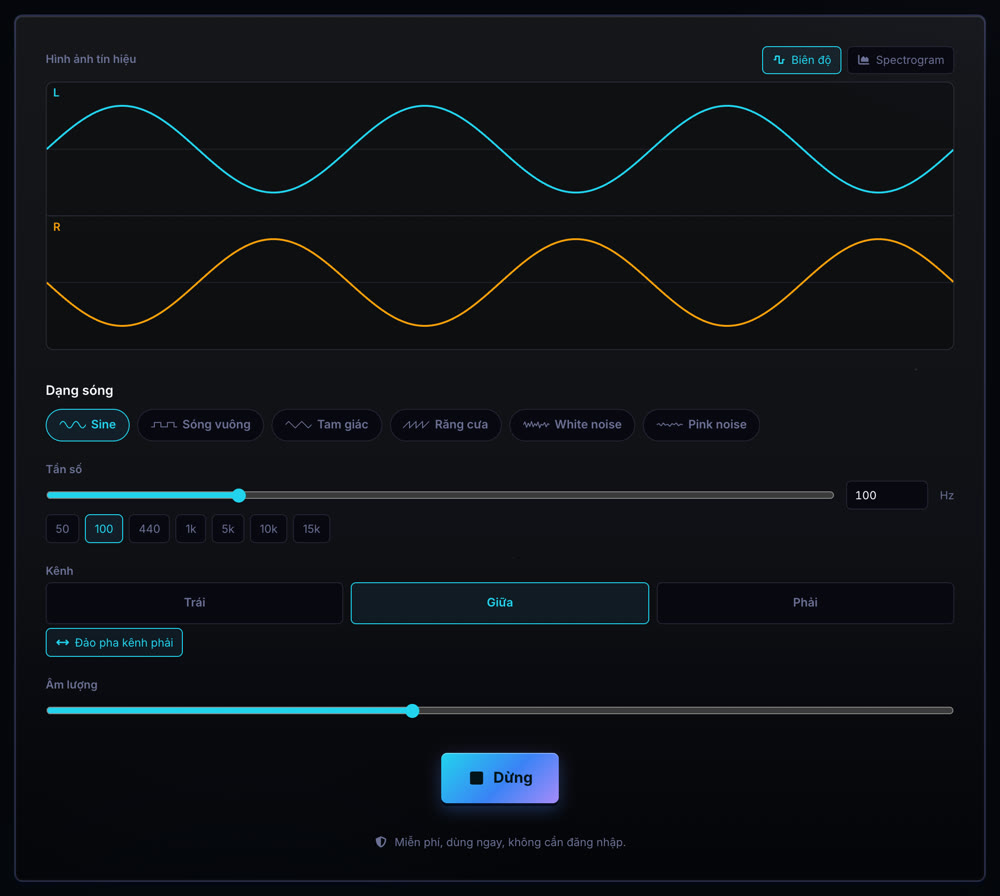
- Open the speaker and headphone test, choose Sine, tap the 100 preset and pick Center so both speakers play the same signal.
- Press Play, listen for a few seconds and note how full the bass feels.
- Turn on the right-channel phase invert and listen again. Toggle it a few times to compare.
- Read the result: if inverting makes the bass clearly thinner and spread out, the pair is wired correctly. If inverting makes the bass fuller and more centred than with it off, one speaker is wired backwards.
Why test with a low-frequency sine?
At 100 Hz the wavelength is about 3.4 m, longer than the spacing of most speaker pairs in a room, so out-of-phase speakers cancel at nearly every seat. The thinning is obvious.
At high frequencies the wavelength is only a few centimetres, and the pattern of reinforcement and cancellation shifts with every head movement, so what you hear is unstable. If your speakers are too small to play 100 Hz clearly, try 150 Hz or 200 Hz.
How do you fix out-of-phase speakers?
- Switch off the amplifier or speakers before touching any cable.
- Look for the marking on the speaker cable: one conductor usually has a stripe, printed text or a different colour. Whatever lead goes to red (+) on the amp must go to red (+) on the speaker.
- Swap the two leads on one speaker only, never both.
- Switch back on and repeat the phase-invert test to confirm.
Cable not marked? Disconnect it from the amp and briefly touch a battery across the two leads: if the woofer cone moves outward, the lead on the battery's positive terminal is the positive lead. Keep the contact very short.
Can headphones be out of phase?
Rarely, unless someone re-soldered the cable. The bass test above only works with speakers, because their sound mixes in the air. With headphones each ear gets its own channel, so the bass does not cancel; inverting only makes the sound feel odd, diffuse and hard to place. To check headphones, run a left and right test instead.
Systems with a subwoofer often have a phase switch (0 and 180 degrees) on the sub. Keep whichever position gives fuller bass at your listening seat.
Primary sources
Can out-of-phase wiring damage speakers?
No. Reversed polarity does not harm the speakers or the amplifier; it only cancels bass and blurs the stereo image. Fix the wiring and it sounds normal straight away.
Do computer speakers need a polarity check?
Computer speakers and soundbars come with fixed factory wiring, so reversed polarity is rare. The fault is common with separate speakers on bare wire, car audio and subwoofers.
What if inverting sounds the same either way?
Usually the speakers cannot reproduce the test frequency, or the room is very reverberant. Retry at 150 to 200 Hz, sitting closer and centred between the speakers.