How many Hz can you hear? A sine hearing range test
Test your hearing frequency range with sine tones from 20 Hz to 20 kHz in the browser, and learn why the top end fades with age and gear.
What frequency range can humans hear?
Human hearing is commonly given as 20 Hz to 20,000 Hz (20 kHz), though it varies a lot between people, especially at the top. A hearing frequency range test finds those two end points for you personally.
The upper limit falls gradually with age, starting surprisingly early. Age-related hearing loss (presbycusis) usually takes the highest sounds first, such as a phone ringing or a microwave beep, before spreading down to lower frequencies.
How to test your hearing range, step by step
- Use headphones, not laptop or phone speakers: small speakers cannot play either end of the range.
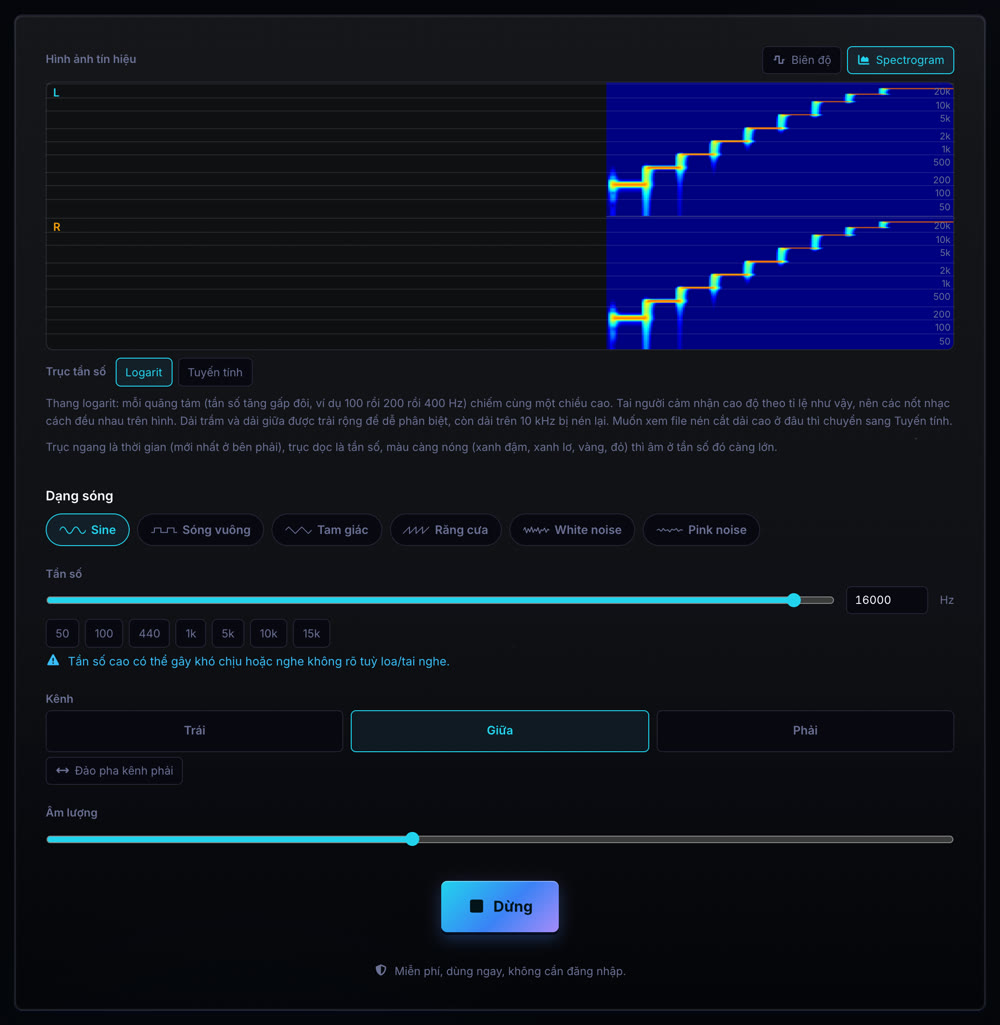
- Open the speaker and headphone test, choose Sine and Center, and tap the 1k (1 kHz) preset.
- Press Play, set the volume so 1 kHz is clear but comfortable, then keep that level for the whole test.
- Tap the 5k, 10k and 15k presets in turn, then type 16000, 17000, 18000 into the frequency box. The last one you can still hear is your upper limit.
- Do the same for the bass: tap 100 and 50, then type 30 and 20. The last one you can still hear or feel is your lower limit.
What does the result tell you?
The limit you find belongs to the whole playback chain: your ears, the headphones, the sound card and the browser. Not hearing 18 kHz could be your ears or headphones that do not reach that high. To isolate your ears, retry with a different, better headphone.
Not hearing above 16 kHz is very common in adults and barely affects music listening, since most of a song's energy sits much lower.
This is not a medical hearing test. If you notice ringing, weaker hearing on one side, or trouble following speech, see an ear, nose and throat specialist.
How far can your speakers or headphones reach?
The same sweep shows the limits of your gear. Probe the bass on speakers: laptop and phone speakers are usually weak in the deep bass, while larger speakers can be felt as far down as they reach. A rattle or an object buzzing along at one frequency is a resonance in the speaker or the room.
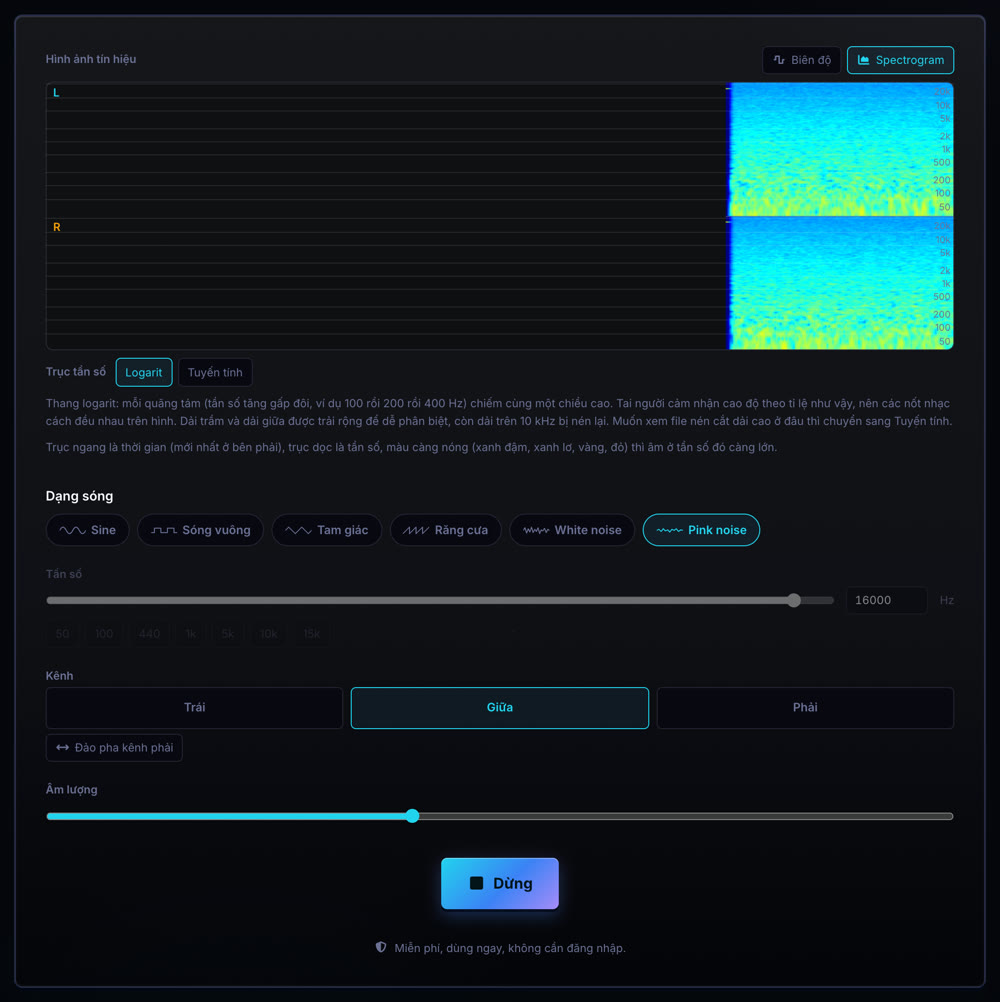
Pink noise helps you judge overall balance because it has equal energy in every octave. If you suspect the music file itself has its top end cut, inspect it with the spectrogram, as shown in spotting fake lossless with a spectrogram.
Is listening to high frequencies harmful?
Loudness and listening time do the damage, not high frequencies as such. According to the WHO, adults can safely listen at about 80 dB for up to 40 hours a week; every step louder cuts that safe time sharply.
High sine tones sound piercing and tire the ear quickly, so keep tests short, rest between runs, and never turn the volume up to chase a high tone you can no longer hear.
Primary sources
Why can I not hear 17 kHz even though I am young?
Your headphones may not reach 17 kHz, or your upper limit may already sit below it, which is fairly common. Retry with another headphone to tell the two apart.
Is an online hearing range test accurate?
Good enough to compare and find a relative limit, not to diagnose. The result depends on your headphones, sound card and volume, so it cannot replace a clinical hearing test.
Should I turn the volume up to hear high frequencies better?
No. Raising the volume to chase a tone near your threshold can overload your ears. Keep the volume you set at 1 kHz for the whole test.